

Like the story 'The Ugly Duckling', I grew up feeling ugly, misunderstood and an outsider, but most of all, confused.
Confused about other people and their behaviours; confused about why I could never keep friends or figure out the social codes of conduct; confused about why people would actively choose to be unkind to each other (and me); and confused about why I apparently was so unlovable.
I was confused about myself too. How could I go from smiling and happy to full of rage after a short walk? Why would I - a pacifist - feel like punching someone when they chewed loudly or whistled? Why did life seem so easy for others to navigate when I sometimes found it nearly impossible? Why did I always become depressed after three months in a full-time job? Why did I lose them again almost as quickly every time I made a new friend? Why did everyone call me 'weird' or 'different,' and why did they think I had a strange sense of humour and laughed too loud at inappropriate things? Why did others not stop to look at buildings and give them personalities? Or stop to remove snails and bugs from the pavement so they wouldn't get stepped on? Or spend the majority of their days wondering how they could make other people's lives better, remembering every detail someone had said so they could, like me, figure out the perfect birthday present?
It was January 2018, and I'd recently turned 35 when I got a referral for a client - my first in my newly established private practice. This young person was Autistic, and I knew nothing about Autism at the time, other than that Autistic people were apparently very difficult to work with.
I held a bachelor's in psychology and a three-year postgraduate diploma in counselling, and I'd only had one lecture on Autism, and it was incredibly ableist.
My first port of call was FutureLearn, which had a free course on Autism that, at the time, featured Dr Damian Milton as a guest speaker. Dr Milton is a sociologist, social psychologist, Autistic advocate and Autistic himself and the man behind the amazing research 'the Double Empathy Problem'.
Considering what I now know about Autism, especially all the harmful research and resources out there, I feel so lucky that my very first access point was this course.
And so, January 2018 was also when the penny dropped and suddenly my confusion, my struggles with my own brain and this lifelong feeling of being a failed human started to make sense. I was not a failing neurotypical. I was a brilliant Autistic person who'd never known how to take care of my specific neurotype.
(I've known since childhood that I'm dyslexic, but in 2018 I understood very little about my dyslexia and was still too ashamed of it to tell people unless strictly necessary. I was formally assessed and confirmed in my dyslexia when I was doing my bachelor's in my late 20s, and dyscalculia was added then too. And it was only in 2017 that I started to realise that I was also dyspraxic (self-identified). However, at the time, all these realisations and labels or identities (as you prefer) came with limited knowledge and resources, very few positive role models, loads of deficit-based information, and a bucketload of shame.
Like most of the people I've worked with, my mind went through a rollercoaster of thoughts and feelings after realising I'm Autistic: What a relief! This explains so much! I have finally found my people! Am I really Autistic, though? Or am I just looking for an explanation that fits, and this is the latest? I can't bother the NHS for a diagnosis, as I'm not "that" Autistic and there are people who need an assessment more than me! I feel like an imposter! But what does this actually change? Is there a next step? I better make super extra sure I'm Autistic before I tell anyone and go down the rabbit hole of research! What if I'm using this as an excuse? I shouldn't take up space in this community when I can manage life on my own. THIS EXPLAINS EVERYTHING! Oh, wait, am I just a list of deficits? Does this mean I can't do or achieve x, y, z? What does it even mean to be Autistic?
So, naturally, I did what any reasonable person would do, and a few months after realising I'm Autistic, I enrolled on a master's in psychology, focussing on Autism (just to make sure I wasn't making this up in my mind…).
Before even starting, I knew my dissertation would be to explore the consequences of figuring out later in life that you're Autistic. In 2018, there was a growing, but still limited, awareness of overlooked women - 'the lost generation' of Autistics and the terms 'female Autism' and 'female Autistic genotype' were doing their rounds (we've since learned that these terms are unhelpful and incorrect).
So, when in September 2018, I told the course director of the Autism master's programme - a Stanford and Cambridge graduate and university professor - that I wanted to focus my research on Autistic women, she told me that women can't be Autistic; they're just anxious.
Yep, that's how far we were in 2018. And in some circles, they're still stuck in the dark ages.
As part of my master's, I did my work placement with an organisation called SWAN (Scottish Women's Autism Network), which was absolutely life-changing and one of the most validating experiences to date. In 2020, during our first year of lockdown, I became the in-house counsellor for SWAN, and in 2021 I joined an Irish organisation, Thriving Autistic, as a freelancer. I also started offering post-identification support sessions for The Adult Autism Practice (they're a neuro-affirmative, strength-based Autism identification practice).
Another interesting fact (perhaps?) about me: I'm Danish. I left Denmark at 21 and moved to London. I then spent a year in Australia and New Zealand before returning to London. In 2009, I moved to Scotland to study psychology (and ride out the financial crisis) and ended up staying for 12 years. After 18 years abroad, I returned to Denmark in late 2021 to be close to my family, though I still feel more at home in the UK and miss it dearly.
I'm a massive book lover - now collecting far more than I'll ever get around to reading, and my workout consists of going to the library to pick up massive piles of books I'll also never read, only to carry them back again. I adore animals (they're much better than humans, right?), I'm a chocolate fiend, a thalassophile, largely solar-powered (though I don't like too-hot weather), and an avid writer.
There's a Danish children's story called 'Prop and Berta'. One day, the man Prop saves a cow named Berta, and that same day they save some magical creatures in the woods who, in thanks, grant Berta the gift of speech. Berta starts talking nonstop about herself and goes on and on and on. Finally, she says, "Enough about me. What about you? What do you think about me?" And with that, I'll sign off this blog post.
Hopefully, we'll meet again.
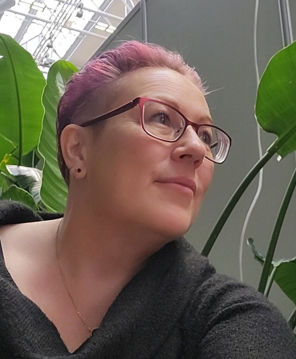
Note: As a dyslexic person, I won't catch all my mistakes. Please read generously, and if you spot any mistakes, I hope you'll smile kindly, because I'm letting myself unmask my dyslexia around you.
All blogs on The School of Thoughts and NeuroStory Collective are written by a human without the aid of generative AI. Enjoy their human imperfection.